Infinite scrolling has become so deeply embedded in modern digital life that most people no longer notice it. It feels natural, almost invisible. You open an app, you swipe, content appears, and time quietly dissolves. What looks like a minor design convenience has, in reality, reshaped how we think, how we spend our days, and how we relate to boredom, focus, and even ourselves.
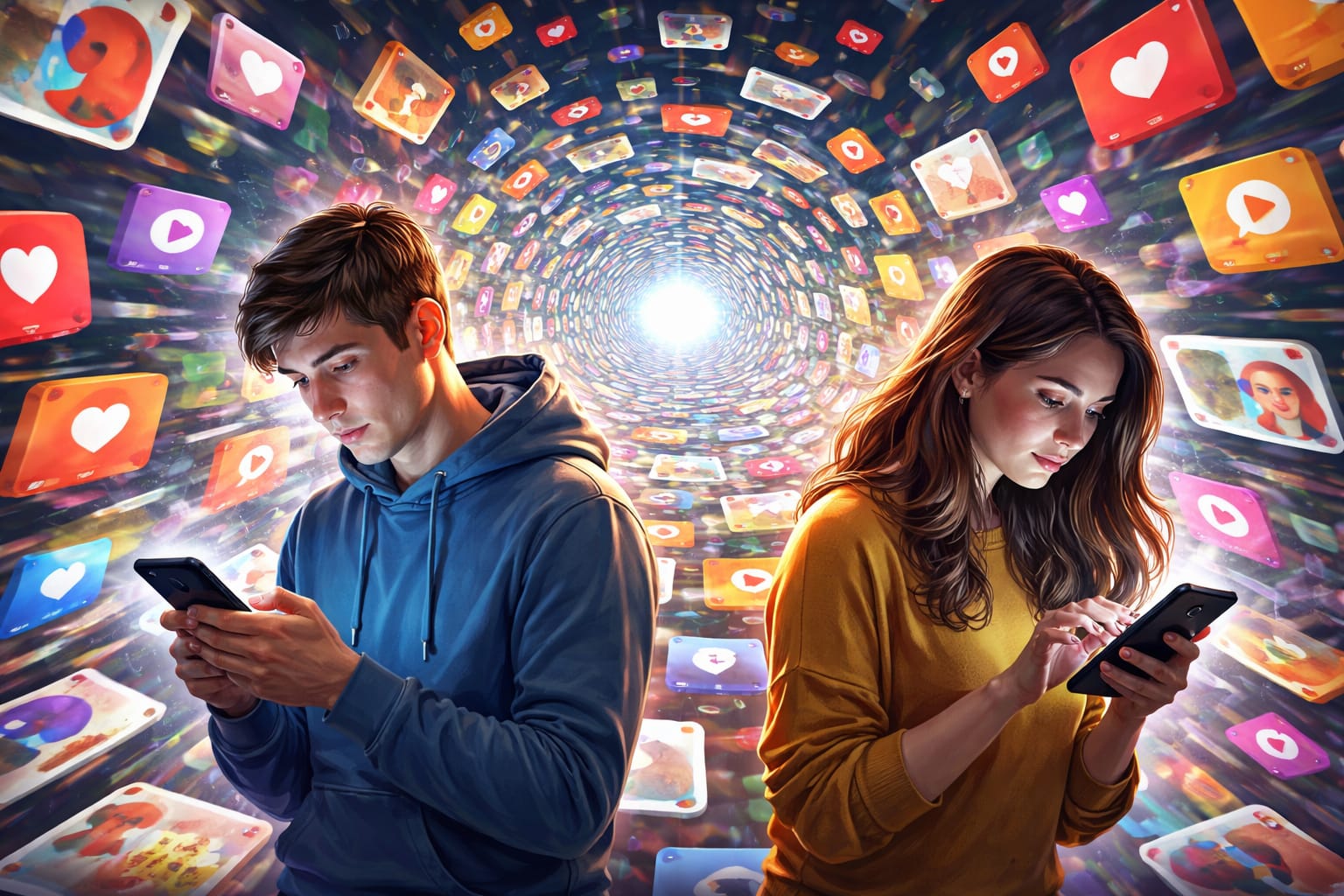
At its core, infinite scrolling removes the idea of “enough.” There is no last post, no final video, no natural pause where the mind is invited to step back and reflect. The result is not simply longer screen time, but a subtle transformation in human behavior. We scroll not because we want to, but because stopping requires effort.
Understanding infinite scrolling means understanding one of the most powerful attention-shaping mechanisms ever created — and why it affects adults and children so differently, yet so deeply.
What Is Infinite Scrolling — and Why It Feels So Natural
Infinite scrolling is a user interface pattern in which content continuously loads as the user moves downward, eliminating pagination, page breaks, or visible endpoints. From a technical perspective, it is elegant. From a human perspective, it is disarming.
The reason it feels so natural is simple: it mirrors physical movement. Swiping down feels effortless, familiar, and almost instinctive. There is no decision-making moment, no interruption that forces awareness. The interface fades into the background, and behavior takes over.
This is where “dumb scrolling” enters the conversation. The term does not describe intelligence, but intentionality. Dumb scrolling is what happens when scrolling stops being a conscious act and becomes an automatic response to boredom, stress, or habit.
In those moments:
- You are not looking for anything specific.
- You are not evaluating what you consume.
- You are simply continuing because the feed continues.
The design invites passivity, and passivity is easy to maintain when there is no signal telling you to stop.
The Birth of Infinite Scrolling: Good Intentions, Unintended Consequences
Infinite scrolling was created in 2006 by Aza Raskin, originally as part of a project focused on improving reading flow. At the time, the web was fragmented. Users clicked constantly, pages reloaded slowly, and content felt disjointed. Infinite scrolling promised continuity.
The intention was practical and, arguably, humane:
- Reduce cognitive load
- Minimize interruption
- Let readers stay immersed
In early implementations, infinite scrolling felt benign. It was used for long articles, image collections, or comment sections where continuity made sense.
But design does not exist in isolation. Once infinite scrolling was introduced, developers began to notice a clear behavioral shift. Users did not just read more — they stayed longer. Much longer. And crucially, they stayed without realizing how long they had stayed.
This is where infinite scrolling quietly crossed a line. A feature designed to improve experience revealed its capacity to extend attention beyond intention.
Years later, even its creator acknowledged that removing stopping cues had consequences he did not fully anticipate. The design worked — just not in the way originally imagined.
The Evolution: How Social Media Turned Infinite Scrolling Into a Weapon
Infinite scrolling became truly transformative when it merged with social media and algorithmic personalization. On its own, infinite scrolling extends sessions. Combined with algorithms, it guides behavior.
Social platforms quickly realized that infinite scrolling solved one of their biggest challenges: how to keep users engaged without asking them to choose. Once feeds became endless and personalized, platforms no longer needed to convince users to continue — the system did it automatically.
Over time, social media companies refined this model by layering:
- Behavioral prediction
- Emotional ranking
- Engagement-based promotion
- Advertising systems optimized for time spent
The feed stopped being neutral. It became responsive, adaptive, and increasingly persuasive.

This shift achieved several outcomes for platforms:
- Users spent more time inside apps without noticing fatigue.
- Emotional content was amplified because it triggered stronger reactions.
- Advertising became more effective due to prolonged exposure.
- Platforms gained unprecedented insight into human attention patterns.
With the rise of short-form video, infinite scrolling reached its most potent form. Videos removed reading effort. Algorithms removed choice. Scrolling became closer to reflex than decision.
What began as a usability improvement evolved into a system that engineers attention.
What Infinite Scrolling Does to the Adult Brain
The adult brain is highly adaptable, which is both its strength and its weakness. Infinite scrolling takes advantage of that adaptability by repeatedly activating the brain’s reward system, especially the dopamine pathways linked to novelty and anticipation.
Each swipe carries a quiet promise: maybe the next post will be better. Over time, the brain begins to crave the possibility more than the content itself. This subtle conditioning shifts how attention works. Depth becomes harder. Slowness feels uncomfortable. Silence starts to feel like something that needs to be filled.
Many adults notice these changes gradually. They may struggle to stay focused on long articles, books, or complex tasks. Moments of boredom — once neutral or even productive — begin to trigger an automatic reach for the phone. The mind adapts to constant stimulation and starts resisting anything that doesn’t offer immediate reward.
Emotionally, the effect can be confusing. People often feel overstimulated yet unsatisfied, busy yet unfulfilled. Infinite scrolling delivers endless input but very little closure. There is no sense of completion, only continuation.
This is why breaking the cycle requires more than willpower. It requires understanding how habits form and how attention can be retrained. If you’re looking for a structured way to do that, AppTrap’s How to Break Phone Addiction explains how to rebuild healthier digital habits gradually, without relying on extreme digital detoxes.
The Impact on Children: A Developing Brain Under Constant Stimulation
For children and adolescents, infinite scrolling is not merely a habit — it is a developmental influence.
Young brains are still forming the neural circuits responsible for:
- Focus and persistence
- Emotional regulation
- Impulse control
- Long-term planning
Infinite scrolling introduces a pattern of instant reward with minimal effort. When this becomes a dominant form of engagement, it can crowd out experiences that require patience, boredom, or sustained attention.
Children exposed to endless feeds may struggle with:
- Waiting without stimulation
- Engaging deeply with books or tasks
- Managing frustration or delay
- Finding motivation without external input
The concern is not that technology exists, but that it fills every mental gap, leaving little space for imagination, reflection, or self-directed thought.
This is why many technology leaders quietly limit screen exposure at home. They understand that systems designed to maximize engagement do not distinguish between adult resilience and childhood vulnerability.
A Philosophical View: The Loss of Endings, Meaning, and Choice
Beyond psychology and neuroscience lies a deeper issue: infinite scrolling changes our relationship with endings.
Human meaning is structured around limits. Stories end. Days end. Conversations pause. These boundaries allow reflection and memory to form.
Infinite scrolling removes those boundaries.
When content has no end:
- Time becomes blurred.
- Consumption replaces contemplation.
- Choice becomes reactive rather than intentional.
You are not deciding when to stop. You are stopping only when exhaustion, guilt, or interruption intervenes.
Philosophically, infinite scrolling shifts us from agents to receivers. We do not seek information; it arrives. We do not conclude; we drift.
In a subtle way, the endless feed mirrors a broader cultural discomfort with stillness. Silence feels unproductive. Pauses feel empty. The scroll fills the gap.
Why Infinite Scrolling Matters More Than Ever
Infinite scrolling no longer lives only inside social media feeds. It shapes how we consume news, how we shop, how we learn, and how we relax. As this design pattern spreads across platforms, it quietly becomes the default way we interact with information.
The real risk is not technology itself, but unconscious use. When systems are designed to remove stopping points and maximize engagement, the responsibility to disengage falls entirely on the user — often at moments when attention is already depleted.
This is why more people are reconsidering their relationship with specific platforms rather than blaming themselves for “lack of discipline.” Sometimes, the healthiest response to an attention-hijacking environment is distance.
For some users, that means stepping away temporarily. Others choose to draw a permanent line. AppTrap offers detailed guides for both approaches, including how to temporarily deactivate your Facebook account, delete Facebook permanently, temporarily deactivate Instagram, or permanently delete your Instagram account.
These actions are not about rejecting technology. They are about restoring boundaries in an environment designed to erase them. In a digital world built around endless feeds, choosing where — and when — to stop becomes an act of intention.
FAQ: Infinite Scrolling and Digital Addiction
What is infinite scrolling?
Infinite scrolling is a design feature where new content loads automatically as you scroll, without page breaks or an end point. It removes natural stopping cues and encourages continuous consumption.
Why is infinite scrolling addictive?
Infinite scrolling exploits the brain’s reward system by constantly offering new content. The uncertainty of what appears next triggers dopamine release, making it difficult to stop scrolling intentionally.
What is dumb scrolling?
Dumb scrolling refers to mindless, automatic scrolling without a clear goal or intention. It often happens when people scroll out of boredom, stress, or habit rather than interest.
Does infinite scrolling affect attention span?
Yes. Frequent exposure to infinite scrolling can reduce sustained attention, increase distraction, and make it harder to focus on long or complex tasks.
Is infinite scrolling harmful for children?
Children are especially vulnerable because their brains are still developing. Infinite scrolling can interfere with focus, emotional regulation, patience, and the ability to tolerate boredom.
Why do social media platforms use infinite scrolling?
Platforms use infinite scrolling to increase time spent on the app, collect more behavioral data, and show more ads. It removes friction and keeps users engaged longer without conscious decision-making.
Can you disable infinite scrolling on social media apps?
Most platforms do not offer a full “disable infinite scroll” option, but you can reduce its impact by turning off autoplay, setting time limits, or deactivating or deleting accounts.
How can I stop infinite scrolling?
You can break the habit by setting app time limits, removing addictive apps, disabling autoplay features, keeping your phone out of reach, and creating screen-free routines.
Final Thoughts: Awareness Is the First Line of Defense
Infinite scrolling was not created as a trap, but it has evolved into one of the most effective attention-capturing mechanisms ever deployed at scale. It extends time, fragments focus, and subtly reshapes how people relate to information, boredom, and choice.
The essential truth is simple:
Infinite scrolling keeps you engaged without asking why.
Recognizing this does not require rejecting technology. It requires reclaiming intentionality. Awareness restores choice, and choice restores boundaries — something endless feeds quietly erase.
In a world where content never ends, learning when to stop may be one of the most important skills we can relearn.